


In retail, “customer experience” used to be won or lost only in-store. Today, it is often won or lost in fulfillment—now an order is promised, picked, packed, and handed to a carrier. For distribution and fulfillment leaders, the challenge is not simply higher e-commerce volume. It is that buying behaviors have changed the shape of demand, and many operating models were not designed for that shape.
By the numbers: the scale is already here
E-commerce is no longer an “emerging” channel. In 2024, U.S. retail e-commerce sales were estimated at $1.1926 trillion and 16.1% of total retail sales.

Just as important, growth is increasingly driven by channels that are volatile, demand-spiky, and promotion-driven.
- Social commerce is crossing into the mainstream. EMARKETER projects U.S. social commerce sales will surpass $100B in 2026.
- Shopping is becoming more AI-assisted. A Deloitte consumer survey (as reported by Digiday) found 56% of U.S. consumers planned to use AI chatbots to compare prices/find deals, and 47% planned to use AI to summarize reviews before purchasing.
- “Agentic” commerce is being actively marketed and tested. Checkout.com research reported that “nearly half” of consumers expect to use an AI agent for Christmas shopping in 2026.
The operational implication is straightforward: demand is being shaped by more micro-moments, more channel mix, and more time-sensitive promise windows, which will continue to impact the future of operations:
- Demand volatility moves upstream into the DC. Peaks become less calendar-driven and more trigger-driven.
- Inaccurate delivery promises and slow order release times lower the customer experience.
- Speed expectations persist even as margin mix shifts downward, tightening the economics of every touch.
Why legacy wave fulfillment is struggling
Many fulfillment operations are still organized around wave logic, batching work into long, large release cycles. In a world of tighter promise windows and demand volatility, batching creates friction that shows up as congestion, labor waste, and missed cutoffs.
The dwell-time problem: wave processing introduces unavoidable waiting; orders sit until the wave closes or downstream capacity becomes available. This wait time increases expedites, exceptions, and cancellations.
Labor is spent on non-value work: batch-based execution often forces labor into non-value time: walking, waiting, requesting work, re-handling, and wave transitions. You absorb waste precisely when labor is hardest to staff and most expensive to flex.
You hit throughput ceilings faster than expected: even with added headcount or automation, rigid release logic can create a throughput ceiling. The constraint is the operating model, not the equipment or labor count.
The Future of Keeping Up with Demand
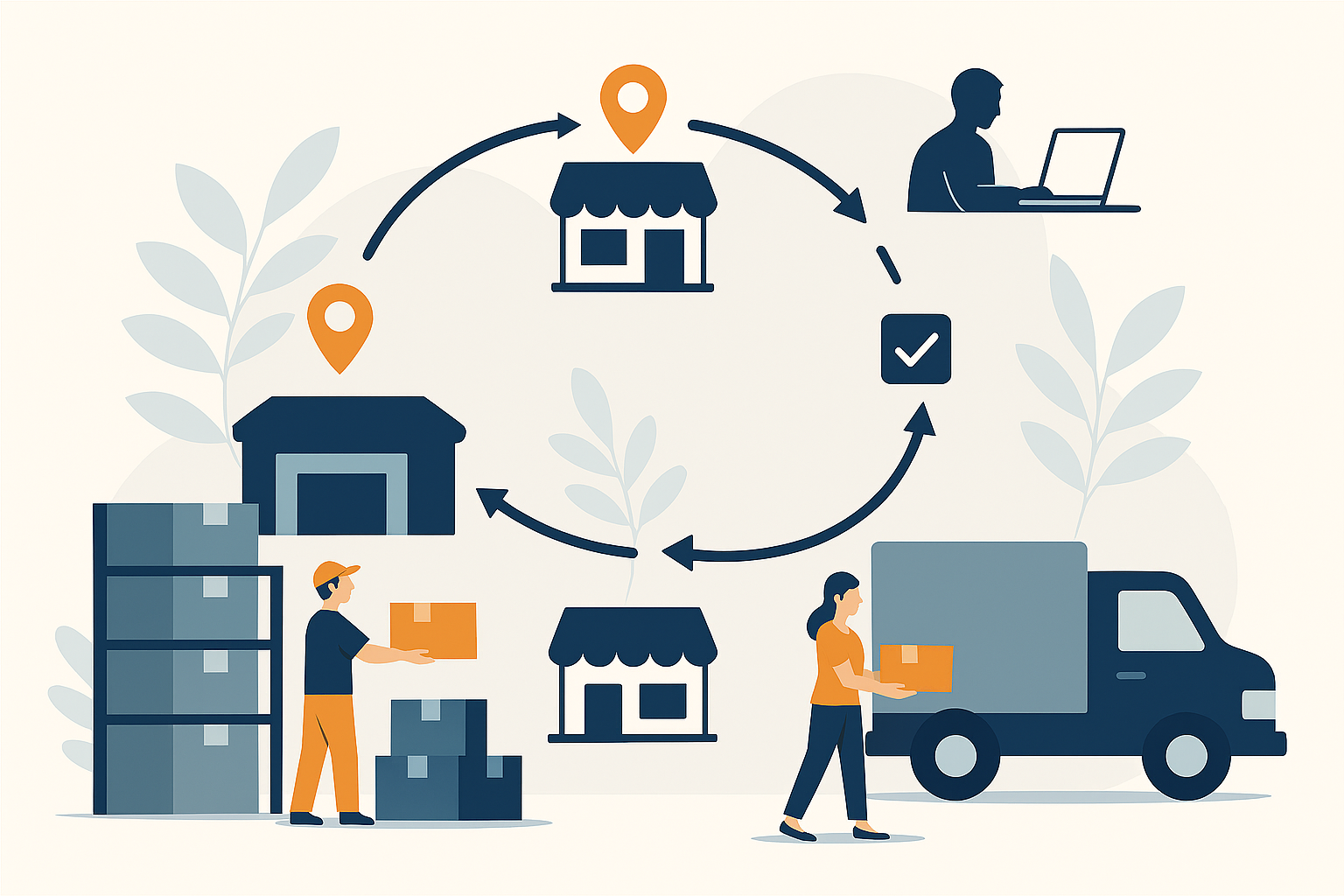
The network is changing from single-node efficiency to multi-node orchestration. Retailers are redesigning their fulfillment networks to protect margin and meet tighter delivery expectations. The most common move is simple in concept: place inventory closer to the customer, but complex in execution. Regional DCs, micro-fulfillment, ship-from-store, and 3PL nodes can reduce shipping costs and improve speed, but only if the network operates as one coordinated system.
In practice, many networks become more distributed but not more synchronized. Inventory may be closer, yet decisions remain fragmented across OMS, WMS, store systems, carrier rules, and manual workarounds. The result is familiar: higher split shipments, inconsistent service levels, reactive expediting, and capacity imbalances where one node is overwhelmed while another has slack.
The differentiator going forward is orchestration: the ability to continuously decide, across all nodes, what should ship from where, when, and how, based on real constraints and economics.
Moving from wave to flow: what “waveless” looks like in practice
If the network shift occurs where fulfillment happens, the operating model shift is how work is executed within each node. Traditional wave-based fulfillment was built for predictability: batch orders, release work in cycles, and push volume through the building. That breaks down when demand is volatile, promise windows are tight, and mix changes hourly.
A waveless (continuous) operating model replaces periodic batch release with continuous order flow—releasing, prioritizing, and sequencing work dynamically as orders arrive and conditions change. Instead of forcing orders to wait for a wave, the system behaves more like a traffic controller:
- Orders are prioritized in real time by SLA, cutoff, customer value, and downstream constraints
- Work is continuously rebalanced across zones, automation, and labor to reduce congestion and idle time
- Sequencing adapts as inventory status, carrier schedules, and equipment capacity change
- Exceptions are managed earlier (before they become missed cutoffs or last-minute expedites)
This requires an orchestration layer that connects OCS/WMS and automation under a single set of priorities, so operations can move from “batch efficiency” to flow efficiency: faster cycle times, fewer touches, reduced split shipments, and more reliable delivery performance.
The headline: in a world defined by micro-peaks and tighter promises, the winning model is not “run waves harder.” It is run the network and the building as a continuously optimized flow.