

Dan PerrySenior Systems Engineer
When visitors tour facilities powered by COFE®, they often ask to see “the control room” or “master control room”. The place where operational decisions are made and workflow is managed. When we explain that no such centralized control area exists in COFE®-driven operations, it can be difficult for them to imagine how the facility functions effectively.
Historically, master control rooms were uncommon. Over time, they became a standard feature as fulfillment operations grew more complex, and response times shortened. The shift was driven by the need for rapid coordination, immediate communication, and constant visibility across processes in fast-moving distribution environments. COFE® represents a different operational model; one designed to meet today’s fulfillment demands without relying on centralized, human-dependent control structures.
Rethinking Distribution Center Operations Management
Operations management in COFE®-driven facilities differs fundamentally from traditional distribution centers. To illustrate these differences, operations management can be viewed across five core categories:
- Labor forecasting and future staff availability
- Work planning, including work selection and sequencing
- Deployment of labor across process areas
- Detailed labor tasking within individual processes
- Equipment management and operational monitoring
In traditional distribution centers, these functions are often consolidated into a single master control room. This is the perceived “heart” of the operation. Even in upgraded facilities, the goal remains the same: enable immediate communication between managers responsible for different operational functions.
As fulfillment expectations have accelerated, the need for instant responsiveness has become unavoidable. Operational plans that allow hours, or days, to react are no longer viable. However, reliance on centralized human oversight introduces limitations that can compromise responsiveness.
Responsive Workflow Management
Many operational management functions require constant observation and immediate reaction to changing conditions. Expecting floor or section supervisors to continuously manage workflow is unrealistic. Supervisors are frequently pulled away by competing responsibilities, leaving workflow conditions unmonitored. When this happens, operations quickly become non-responsive. In a matter of minutes, a well-performing facility can shift into recovery mode.
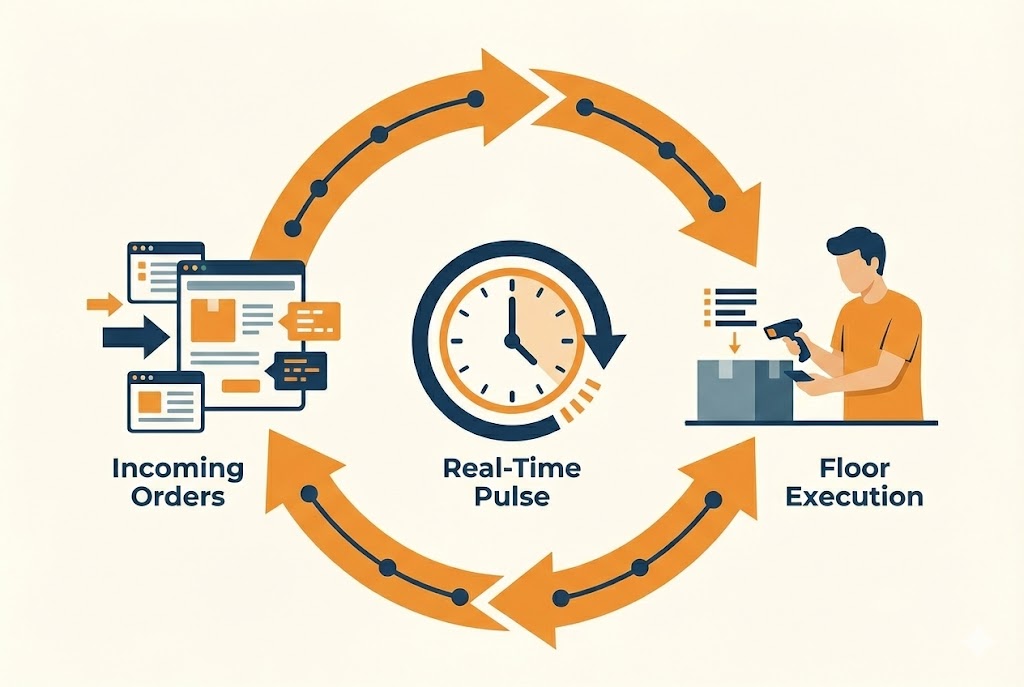
COFE® addresses this challenge directly. As a Warehouse Execution System (WES), COFE® is responsible for controlling and synchronizing work across the operation, creating a cohesive workflow. It operates as a real-time system, continuously reacting to changing requirements and conditions.
COFE® was designed specifically to support rapid response and continuous observation capabilities that are essential for managing modern distribution operations.
Labor Forecasting
Labor forecasting is a distinct operational management function that does not require real-time coordination with other workflow activities. Instead, it relies on historical performance data and current work information to determine labor requirements for a future day.
COFE® supports this function by providing access to current workload data and historical work rates. Forecasters analyze this information to develop labor forecasts, while COFE® remains focused on real-time execution rather than predictive staffing decisions.
Workforce Deployment
Workforce deployment differs from labor forecasting because it requires immediate, real-time decision-making. Deployment determines how available labor is distributed across and within processes to achieve a desired workflow.
In traditional environments, master control room managers typically handle workforce deployment across processes, while floor supervisors manage deployment within a specific process area. COFE® changes this dynamic by embedding deployment intelligence directly into the execution layer of the operation.
Intelligent Distribution Center Operations Management with COFE®
The following sections focus on the operational management functions handled directly by COFE®, organized by management category.
Work Planning and Sequencing
Work planning involves selecting and sequencing the work to be performed. COFE® typically receives work as individual delivery requirements, which may arrive in real time and do not require pre-sequencing. Traditional work planning methods focus on forecasting labor availability, determining required work quantities, sequencing tasks, and aligning resources to predict when work will be completed.
COFE® uses a different paradigm. Work planning in COFE® is not tightly coupled to labor resource planning. Instead, it focuses solely on prioritizing and sequencing work and determining the order in which it will be completed. Labor availability is addressed separately through deployment mechanisms rather than embedded into the planning process itself.
Macro Deployment of Labor
Macro deployment refers to the distribution of the total available workforce across operational processes. In continuous-flow operations, the objective is to maintain balance: each process operates continuously, drawing from upstream processes and feeding downstream processes at a consistent rate. Buffers between processes are intentionally limited, holding only enough work-in-progress to allow labor redeployment while maintaining flow.
Within this model, labor is deployed as a ratio across processes rather than as fixed assignments. COFE® continuously monitors production levels at each process and detects imbalances with greater precision than human observation.
When COFE® identifies a growing work queue in one area or a declining queue in another, it provides this information to decision makers early. This happens well before imbalances escalate into production issues.
Automated Micro Deployment
Micro deployment, sometimes referred to as tasking, occurs within individual processes. COFE® automatically deploys available labor at the micro level to balance output within a process. When a process becomes overstaffed, COFE® informs workers that no work is available, ensuring labor is not misallocated and maintaining operational balance.
Equipment Management and Monitoring
Effective operations management also depends on real-time equipment monitoring. Tools such as HMI screens, buzzers, lights, conveyor motor status indicators, automated emails, texts, and radios are commonly used to identify mechanical anomalies. In COFE®-driven systems, equipment controllers send mechanical condition information directly to COFE®. The technology then uses this data to automatically adjust the operation of other processes as needed, ensuring continuity of product flow despite equipment issues.
Summary
COFE®-driven systems eliminate the need for master control rooms as a means of communicating operational conditions and coordinating decisions. Operational data is continuously monitored and automatically acted upon by COFE® to maintain workflow and product movement.
By removing manual work planning and sequencing decisions, reducing workforce deployment to a macro level, and directly incorporating equipment conditions into execution decisions, COFE® functions as a powerful, intelligent WES software solution for distribution center operations management.
Contact VARGO® to learn how COFE® is replacing master control rooms by intelligently monitoring and managing distribution center operations.