

The Labor Challenge in e-Fulfillment
The U.S. e-commerce landscape has entered a period of digital normalization, following years of rapid expansion and structural change. Over the past five years, the market has nearly doubled in size, and while growth is expected to continue, it is doing so at a more moderate and sustainable pace. Forecasts project annual e-commerce growth rates above 8.5%, with retail penetration approaching 29% by 2030 (McKinsey, 2024). As the market matures, growth is increasingly driven by efficiency gains, AI-enabled transactions, and emerging buying channels such as social and agent-led commerce rather than by new customer adoption alone (McKinsey, 2024).
At the same time, fulfillment operations face mounting labor challenges. Warehouse roles now compete directly with food service, retail, and other hourly industries as minimum pay rates rise, compressing wage differentiation. Competition from the “gig economy” further reduces the available labor pool by offering flexible, short-term earning alternatives.
High turnover among frontline associates compounds these pressures. Constant churn creates an ongoing cycle of hiring and training, limiting productivity gains and placing additional strain on operations during peak periods such as the holiday season, when volume hiring becomes necessary. As e-commerce demand continues to scale, organizations are increasingly turning to workforce optimization technologies such as COFE® and targeted automation to stabilize operations, improve productivity, and reduce reliance on continuous labor expansion.
Goods-to-Person Overview
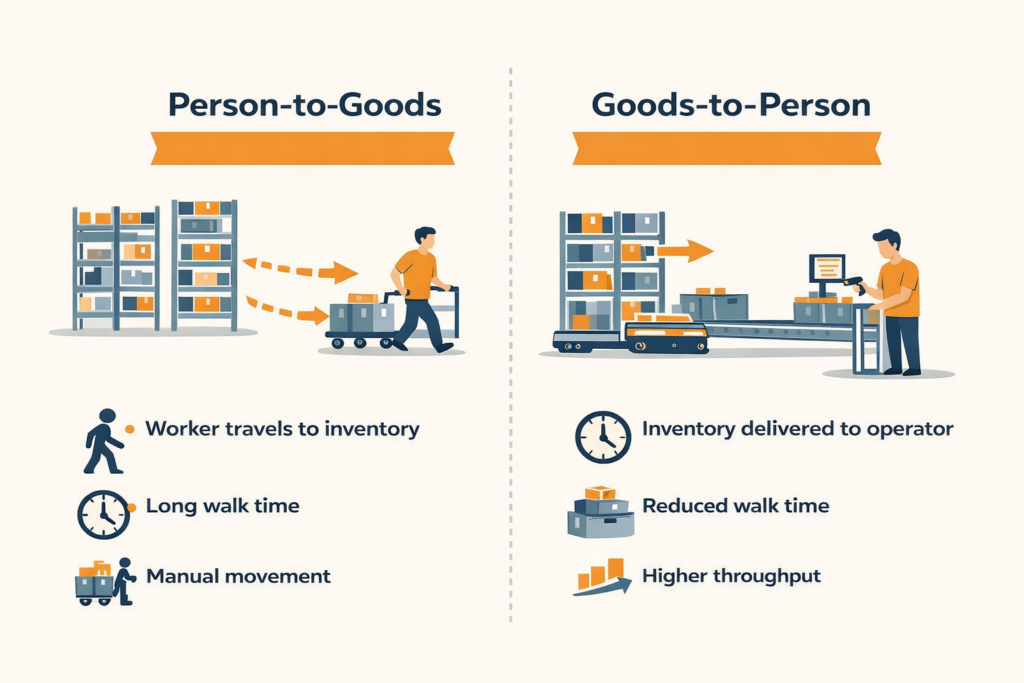
Alongside rising labor costs and sustained ecommerce growth, goods-to-person (G2P) solutions have become increasingly prevalent. Advances in robotics have shifted interest away from the traditional person-to-goods model, though both approaches offer distinct advantages and limitations. At a high level, fulfillment centers typically operate using one of two picking methodologies:
Person-to-Goods (P2G)
Person-to-goods is the traditional picking method used in fulfillment centers worldwide. In this manual model, order fillers travel through the warehouse to pick products or SKUs individually and transport them to designated areas for further processing prior to shipment.
P2G equipment requirements are minimal for smaller, lighter goods and low volumes, often limited to carts or trolleys. Larger or heavier goods require forklifts. Technologies such as radio-frequency scanning, pick-to-light, and voice-directed picking can improve accuracy and throughput for higher volumes.
Goods-to-Person (G2P)
Goods-to-person systems use automation to deliver products or SKUs directly to an operator’s workstation. Operators remain at their pick stations while required items are presented to them. Correct quantities are picked, and remaining inventory is automatically returned to storage. By eliminating operator travel to and from storage locations, G2P significantly reduces non-productive time associated with walking and material handling.
Types of Goods-to-Person Technologies
Automatic Storage and Retrieval Systems (ASRS)
ASRS are computer-controlled systems designed to store inventory in a compact footprint and retrieve SKUs automatically using shuttles or cranes operating within a fixed structure.
Autonomous Mobile Robots (AMR)
Autonomous mobile robots navigate fulfillment centers without direct operator control. Using sensors, onboard computing, and digital maps, AMRs retrieve and deliver SKUs to operators. While all AMRs navigate using X and Y coordinates, newer designs can also operate along the Z axis, enabling vertical movement. While many G2P facilities rely on traditional carton-level ASRS solutions, ongoing advancements in robotics have driven increased adoption of AMR-based picking systems.
How Goods-to-Person Addresses Labor Challenges
Picking is often the most labor-intensive activity in a fulfillment center. Traditional P2G operations require extensive physical effort, including lifting totes, pushing carts, and walking long distances throughout a shift. One of the most significant benefits of G2P systems is their ability to reduce labor requirements by automating repetitive, time-consuming, and non-productive tasks.
Productivity and Accuracy Improvements
Order picking consists of three primary time components:
- Setup and discharge time
- Walk time
- Bin face time
G2P systems improve efficiency across all three. While automated equipment helps reduce setup and discharge time, the largest productivity gain comes from eliminating walk time. In traditional P2G environments, approximately 45 minutes of every 60-minute picking hour is spent walking. By limiting operator movement to product handling at the workstation, productive time increases significantly, resulting in higher throughput.
At the bin face, G2P further improves performance by allowing operators to focus on accurate order processing while robots handle retrieval and storage. Automated picking systems also reduce errors such as selecting incorrect items or picking from the wrong location.
Space Utilization Benefits
A G2P system typically includes:
- Storage locations (cartons or totes)
- A transport system (conveyor or robotic)
- Operator workstations
G2P configurations are highly adaptable and can be designed to optimize available floor space. One of the greatest advantages of G2P is improved storage density, particularly using vertical space. ASRS solutions are significantly more compact than traditional P2G layouts and can be constructed up to 100 feet high. Facilities with clear heights exceeding 40 feet benefit most, as ASRS enables use of vertical space that would otherwise remain inaccessible.
Reduced Risk of Injury
By minimizing travel and automating material handling, G2P systems reduce the risk of workplace injuries such as falls and strains, lowering both the frequency and cost of workers’ compensation claims. Additionally, G2P work cells limit unnecessary human contact, which can support productivity and reduce the spread of illness.
Selecting the Right G2P Solution
There is no universal goods-to-person solution. G2P systems are capital-intensive, making careful evaluation critical. Organizations must consider fulfillment profiles, space constraints, throughput requirements, and budget when selecting a solution. While AMRs offer flexibility and adaptability, a wide range of ASRS technologies exist, each suited to different product types, volumes, velocities, and throughput demands. Storage density and throughput goals should be primary decision factors.
G2P Technology Categories
Shelf-Based Picking
Entire shelves or trays are delivered to the operator. Technologies include:
- Vertical carousels
- Horizontal carousels
- Vertical lift modules (VLMs)
Bin-Based Picking
Individual bins or totes are delivered to operators using dense vertical storage. Technologies include:
- Crane-based mini-load ASRS
- Vertical buffer modules (VBM)
AMR-Based Picking
Robots retrieve and deliver SKUs using flexible shelving systems, including:
- Robotic shuttles
- Floor robots
- Climbing robots capable of X, Y, and Z movement
Donors and Targets: Workstation Configurations
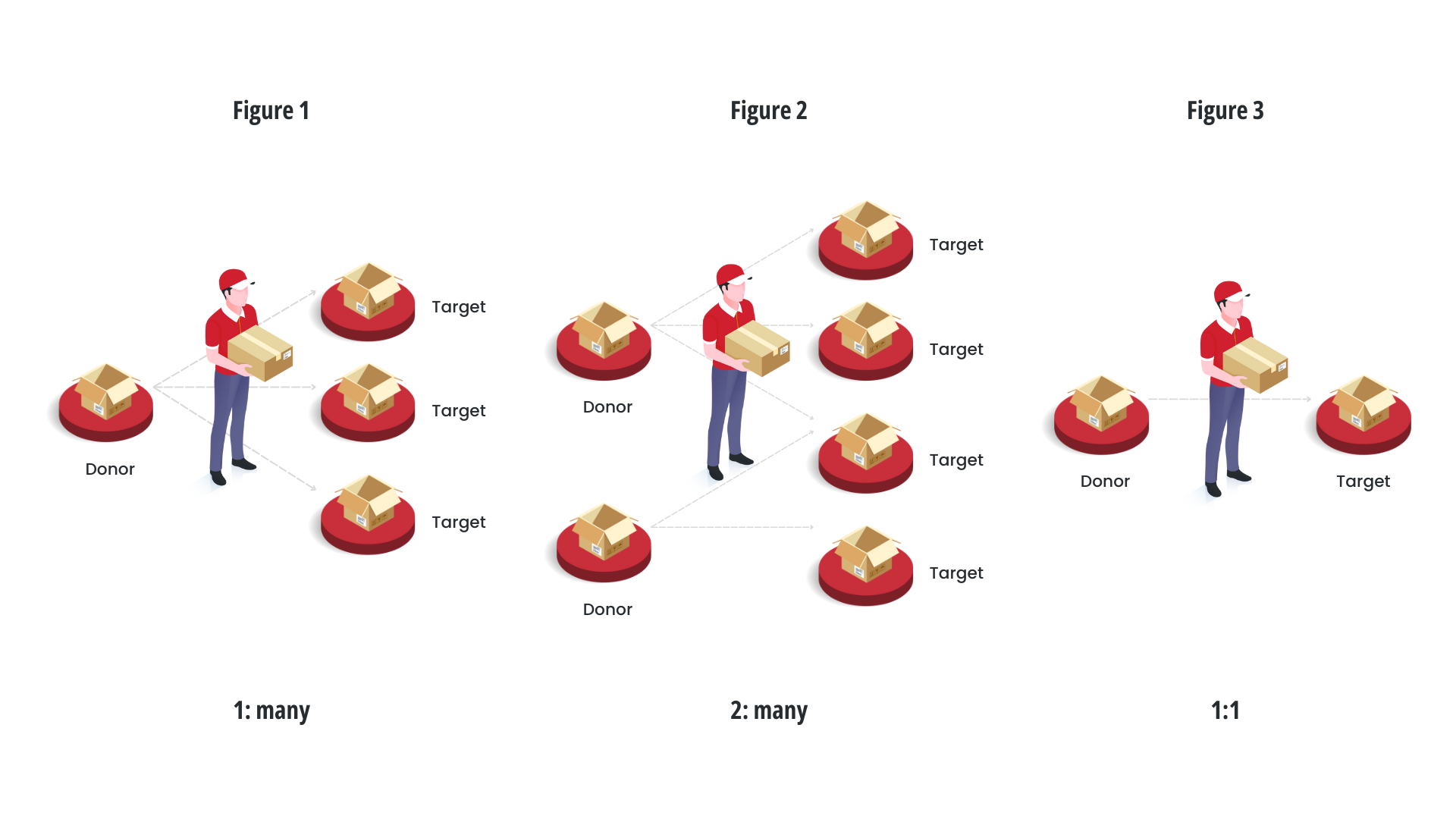
In G2P systems, donor totes contain inventory retrieved from storage, while target totes contain order-specific products moving downstream. Workstation configurations vary:
- One donor to many targets increases efficiency by maximizing work per retrieval.
- Multiple donors to many targets reduce exchange time between donor totes.
- One donor to one target minimizes setup, discharge, and bin face time.
The rate at which donor totes are presented directly influences workstation throughput.
Storage Density Comparison
Using 100,000 square feet as a baseline:
- Traditional 4-level pick modules offer low density due to aisles, conveyors, and supporting infrastructure.
- Very narrow aisle (VNA) deck rack improves density but relies on forklift labor, which is difficult to hire and retain.
- ASRS case load systems provide the highest density, utilizing vertical cube space up to the full clear height of the building.
Data-Driven G2P Design
Data analytics play a critical role in G2P system design. Common inputs include:
- Units per order
- Active SKUs
- Hit-to-pick ratios
- Item cube
- User productivity
- Travel distances
- Shift schedules
- Fatigue factors
Because ecommerce demand is dynamic and unpredictable, designs must prioritize flexibility and scalability. Analytics should be applied carefully, validated with stakeholders, and balanced to avoid over-optimization.
Inventory Strategy for ASRS
What inventory is stored in ASRS significantly impacts productivity and throughput. While it may seem intuitive to store only high-velocity (“A-mover”) SKUs, this can create inefficiencies during peak demand. During peak periods, A-movers can be positioned outside the ASRS and closer to workstations, allowing the system to focus on B- and C-movers and operate at a steadier flow. Matching SKU velocity and peak-to-mean ratios to workflow requirements is essential.
Theory of Constraints in G2P Systems
G2P systems are governed by both fixed constraints and variable constraints.
Fixed constraints include:
- Machine cycles per hour
- Transportation speed
- Inventory capacity
- Maximum number of G2P stations
Variable constraints include:
- Units per order
- Active SKUs
- Hit-to-pick ratios
- Operator productivity
Successful G2P design requires accounting for both types and building flexibility into the system from the outset.
Warehouse Execution and Workflow Integration
A warehouse execution system (WES) integrates people, machines, inventory, and material flow into a synchronized, real-time operation. Like conducting an orchestra, a WES balances resources dynamically to maintain flow. COFE® applies manufacturing execution principles to warehouse environments, sequencing and synchronizing workflows while minimizing work-in-progress and buffers. As a true WES, COFE® operates in real time and provides the speed and responsiveness required to manage G2P systems effectively.
Best Practices for G2P Success
- Design for flexibility and scalability rather than optimizing around a single data set
- Avoid siloed implementations; integrate G2P with an established WES
- Phase implementation rather than adopting a “big bang” approach
- Maintain alternative workflows and avoid total reliance on automation
- Invest in skilled technical and support staff
- Secure executive buy-in and manage organizational change
Conclusion
Reducing labor and operating costs is essential for profitable fulfillment. Walk time alone can consume up to 70% of an operator’s time. By eliminating these inefficiencies and integrating goods-to-person systems with a warehouse execution platform, fulfillment operations become safer, more efficient, and more productive.
VARGO® brings decades of experience designing and integrating complex material handling solutions. Powered by COFE®, the industry’s most advanced warehouse execution system, VARGO® helps organizations optimize order fulfillment by sequencing and synchronizing workflows to maximize resource utilization.
Contact VARGO® to learn how a goods-to-person solution can be designed, implemented, and integrated to meet your specific business needs.