

Neal Shah, VARGO® Marketing Leader
A few weeks ago, I was listening to Morning Brew on my commute when they ran a segment on GLP-1 adoption rates. I’ve heard plenty of versions of that story, but this time, I couldn’t stop thinking about it from a different angle.
At VARGO®, we spend our days thinking about how returns move through a facility, what they cost, and where they bottleneck. So, when I heard that millions of Americans are losing a clothing size every month or so, one question stuck with me: how will GLP-1 medications impact retailers’ return rate?
We dug into the data. The numbers were bigger than expected, and the trend is still early.
The adoption numbers are already hard to ignore
GLP-1 medications are now a mainstream consumer reality. At current adoption rates, a meaningful portion of your customer base is losing size month over month.
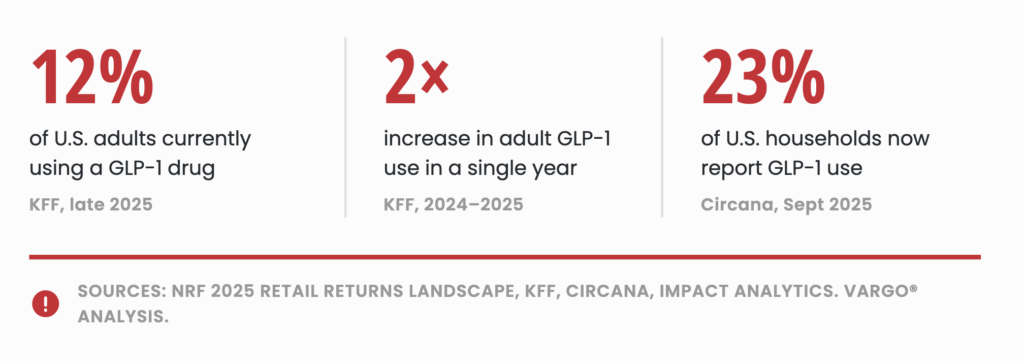
Those figures are still accelerating. Circana’s household data shows adoption climbing roughly 4 percentage points per year. Every quarter, more of your customers are in the middle of a body transformation they didn’t have a year ago.
Why this shows up in your returns
People on GLP-1 medications lose sizes — often one size per month at peak loss, according to Impact Analytics. When a customer isn’t sure whether they’re a medium or a small this month, they don’t guess. They order both and return one.
“The share of apparel exchanges involving customers sizing down has risen for three straight years, hitting 14.6% in 2025 — the highest level on record.”
— Narvar
One online suit retailer put a concrete number on it: returns up 50% in a single year, driven entirely by customers sizing down again and again as the weight came off. Impact Analytics estimates that the size-curve disruption from GLP-1s puts as much as $5 billion in apparel inventory margin at risk nationally, before accounting for the operational cost of processing the returns themselves.
What does your return rate look like in 3 years?
If 1 in 5 orders comes back today, GLP-1 adoption could soon make this number 1 in every 4! Here’s what the math looks like as GLP-1 adoption continues its current trajectory:

For a $1 billion retailer, a 5 percentage-point increase in returns translates to roughly $20 million in lost gross margin, per Impact Analytics. The question isn’t whether this affects you — it’s whether your operations were designed to absorb it.
From “how fast can we ship it?” to “how fast can we take it back?”
Most fulfillment operations were built around a simple assumption: returns are a manageable, relatively stable proportion of outbound volume. That assumption is breaking down.
A returns process that operates sufficiently at, say, 14% can start to strain at 15%, simply because return processes are typically not efficient. So, an incremental increase in returns can have a disproportionate impact on labor allocation, processing time, restocking accuracy, and the speed at which returned inventory gets back into a sellable position. For apparel in particular, an item sitting in the returns queue for two weeks often misses its resale window entirely.
That’s where the conversation has to shift: reverse logistics isn’t a footnote on a forward-fulfillment strategy. It’s a margin lever that deserves to be engineered.
How VARGO® rebuilds the returns flow
VARGO® has worked with apparel and retail brands like GAP to rethink reverse logistics as its own engineered system. That means examining how returns physically move through a facility, how quickly they’re sorted and graded, how labor is allocated between inbound and outbound flows, and where automation can compress the gap between “return received” and “item back in sellable position.”
If your return rate has been increasing over the past two years, or if you suspect it’s about to, it’s worth asking whether your returns process was designed for the volume you’re handling today, or the volume you were handling three years ago.
Let’s look at your returns process.
If you’d like a clearer picture of where your reverse logistics stand, and where the margin opportunity is, we’re happy to walk through it with you.