
What 20 Retail Organizations Told Us About AI in the Warehouse
Over two days in Dublin, Ohio, the VARGO® Retailer Roundtable brought together operators, directors and executives from about 20 retail, fulfillment and supply chain organizations. AI had its own session on Thursday, but it also came up well beyond it, from Wednesday night’s opening panel to the operators and directors discussion.
The AI session opened with a live survey, and the room discussed each question as the results came in. Brooks Hamilton of AI Strategy Advisors then joined to present on practical AI in warehouse and supply chain execution. The overall picture is a group that already uses AI every day, mostly through general-purpose tools, and is interested in where it goes next. They’re also realistic about what’s holding them back.
The Five Takeaways
1. AI is already part of the workday
Every organization in the survey uses Microsoft Copilot, and most pair it with at least one other AI tool. The examples in the room went well past drafting emails. One company built its own internal AI model and loaded it with employee policies, every work instruction in the organization and descriptions of about 600 business reports.
Employees can now ask for a PTO policy, a work instruction or a receiving productivity report and get it right away. A retailer with no e-commerce business described how AI could analyze three years of sales for a category in a matter of hours and propose a store allocation method. In the operators and directors discussion, teams also described using AI to decide where products are stored, write work instructions, train staff and track aging equipment parts.
2. The early payoff is in the work around the floor, and it depends on data
Brooks made the case that the first gains will come from the administrative and management work around operations, where people act as “accidental middleware,” pulling data out of one system, reworking it in Excel and emailing it into the next. The room agreed that getting there starts with data.
“The biggest thing for us is the data availability,” one attendee said. Operators described vendor reporting that rarely answers order-flow questions, and one 3PL now replicates its WES databases to get the live data operations needs. As another participant put it,
“If your data is not clean, AI is going to spit out garbage.”
3. Your SOPs and know-how are becoming business assets
Brooks recommended renting AI models rather than building them, since prices keep falling and building your own is expensive. What organizations should invest in are “skills,” the written instructions that teach AI how to do a job, much like an SOP, and the context behind them. He described both as assets worth treating as a capital expense, because they improve every time outcomes are reviewed and fed back in.
He also expects new responsibilities to emerge, starting as a slice of someone’s existing job: building skills, curating knowledge and data, and understanding how all the pieces fit together. For operations leaders, that makes the documented processes and hard-won know-how inside your buildings worth capturing now.
4. Trust, policy and people set the pace
Internal expertise ranked as the biggest barrier to using AI well, the same skills gap that came up across the event around automation. Tool approval is part of it. One attendee said their company only allows a locked-down version of Copilot, which can’t build the forecasting models their teams want.
Using AI to write a report is one thing, but as one operations leader put it, realizing “an agent’s going to be waving work to the floor” is a big step. Brooks advised being clear about what AI will and won’t be used for, making sure people keep both the decisions and the responsibility for what AI produces, and never using AI to stand in for relationships. Operators also warned about both ends of adoption: resistance, and over-reliance on decisions made “because AI told me to.”
5. Humanoids: curious but careful
On Wednesday night, most of the room said they’d consider letting a humanoid robot work beside their employees, and the largest group wanted to start with a pilot. Very few ruled it out. The interest is real, and so is the demand for proof. In the same set of polls, justifying ROI ranked as a bigger obstacle to automation projects than budget.
Where Operations Leaders Are Placing Their AI Bets
The survey results below put numbers behind those takeaways. They come from people who run fulfillment operations every day, answering live in the room, which makes them a useful gut check for anyone building an AI plan or deciding what to fund next year.
Most are experimenting, and none are scaling yet.

If your organization feels behind on AI, it’s in good company. Most of this room is still working out where AI fits, which means the groundwork of data, policies and training is still being laid. Choices made at this stage will shape how easily AI can grow across the business later.
Expertise and data outrank cost.

This changes what an AI budget needs to cover. The biggest gaps are people who know how to use AI well and data clean enough to trust, rather than software licenses. Leaders planning for next year may get more from training and data cleanup than from adding another tool.
Operators want help making decisions.
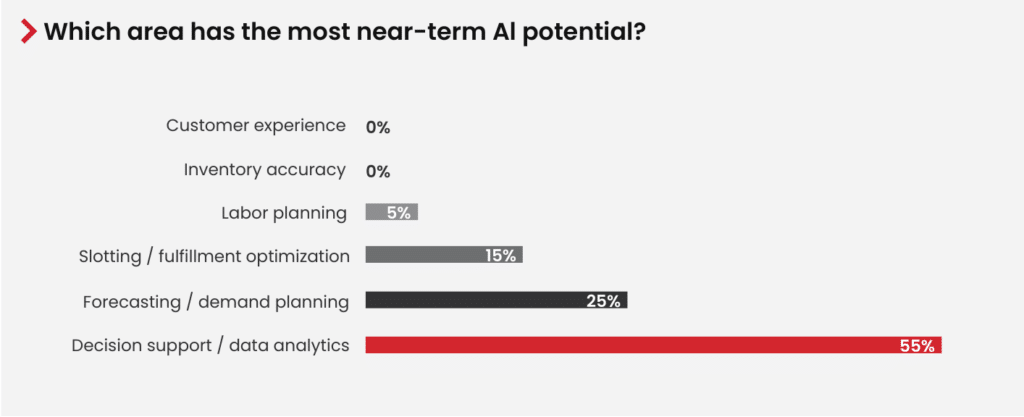
Decision support keeps a person in the loop. AI suggests, and people decide. That fits a group still building trust in the technology, and it lets teams see the value before handing AI any control over floor operations.
Most expect to build their next AI solution themselves.
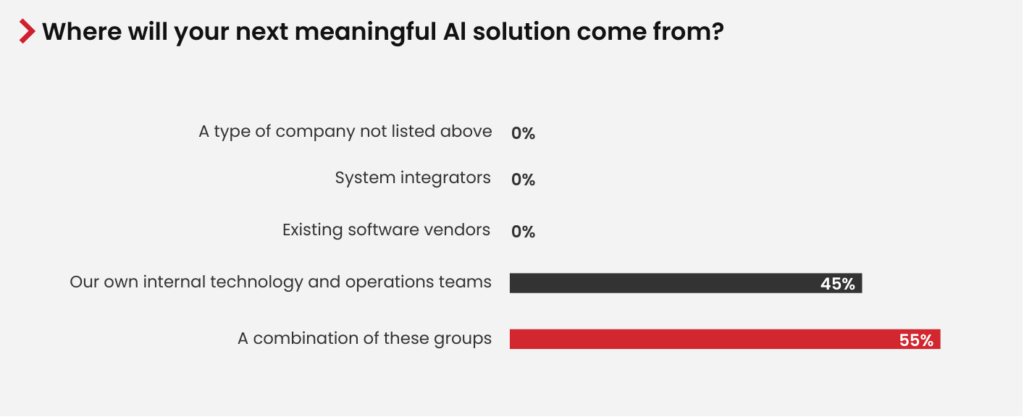
No one expects their next AI win to come from an existing software vendor or integrator. That sits in tension with the barrier results above, because the same internal teams expected to build these solutions are the ones short on expertise. Closing that gap will likely be one of the bigger challenges of the next year or two.
AI is arriving through everyday tools.
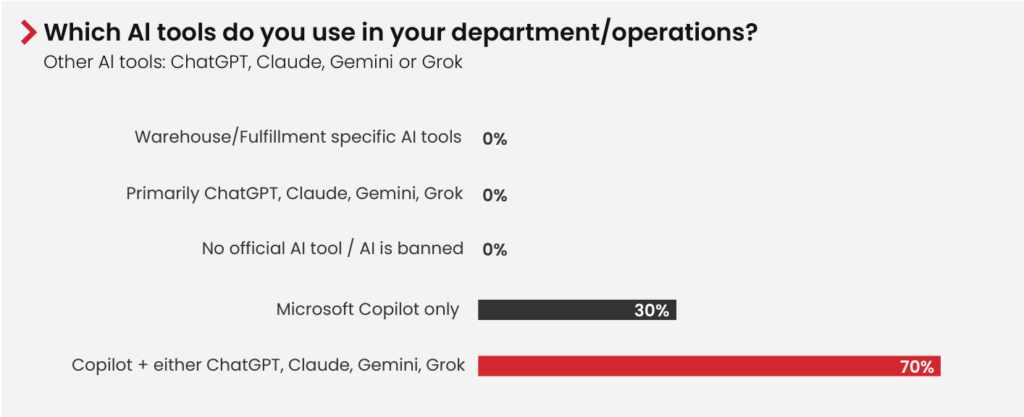
Apart from a few companies building their own internal tools, AI is entering the warehouse through general-purpose desktop tools rather than through the WMS or WES. That makes a clear usage policy important. Without one, people tend to use whatever tools they can find, with company data, outside of IT’s view. With one that’s too tight, teams can’t reach the capabilities they need.
Planning and flow top the AI wish list.
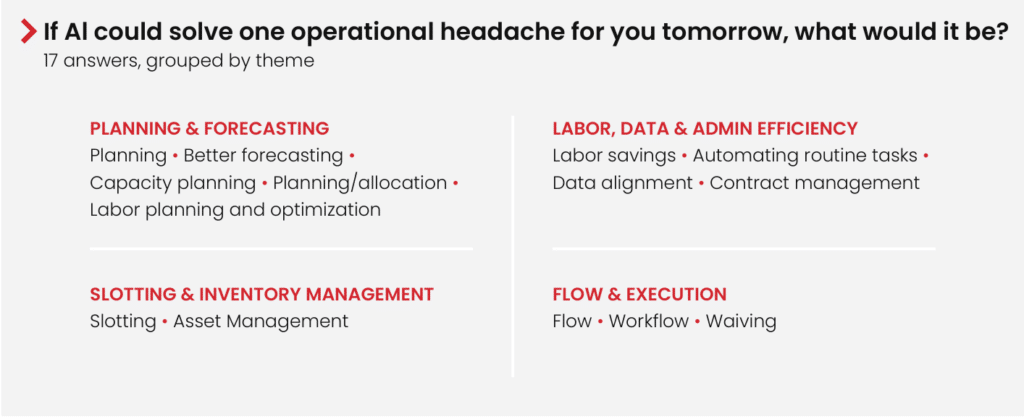
Planning, wave management and admin work all depend on pulling data together from several systems, often by hand. They’re also the kinds of work where faster, better answers can make a noticeable difference day to day.
Operations leaders are open to humanoid robots, with proof.
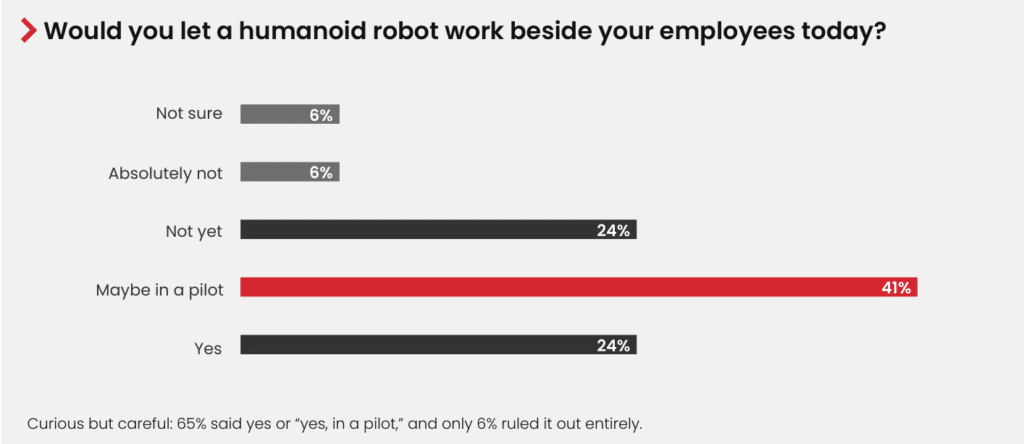
The most popular answer was “maybe, in a pilot,” which says a lot about how this group approaches new technology. They’re open to it, but they want to see it work in their own operation before committing capital.
For retailers evaluating this shift, the conversation worth having is what a de-risked, single-site pilot looks like for your specific operation, and what it would cost to find out. VARGO® is available for that conversation below.